


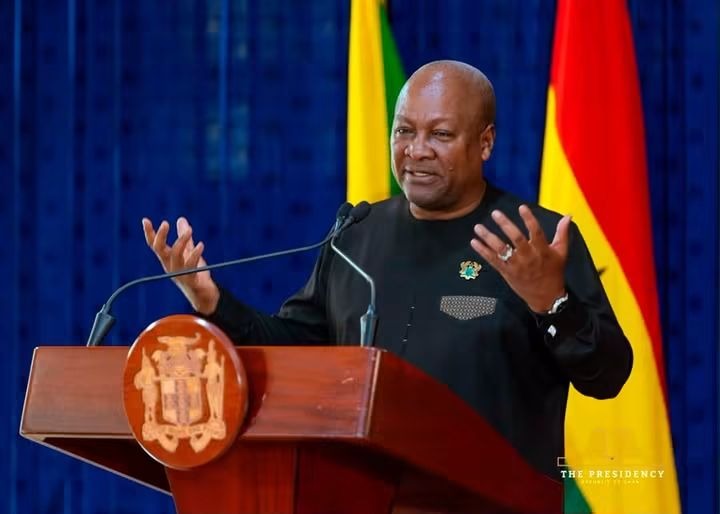
President Mahama stood at the Council on Foreign Relations in New York on September 25 and explained why Ghana told the United States no. He didn't hedge. He said the quiet part out loud.
The deal was worth $109 million over five years, meant to replace funding Ghana lost when USAID was dismantled. But the conditions attached to it were not a partnership. They were a surrender.
"It states that we shall give the United States our pathogen profile," Mahama said.
"It also says we should give our medical records. I mean, who takes another country's medical records?"
Then came the part that made his Cabinet move faster than he had ever seen.
The compact required that any medications or medical products brought into Ghana under the program would be exempt from inspection by the Food and Drugs Authority. "Our FDA has absolutely no rights to inspect. I mean, it was humiliating".
He said the document "was thrown out in record time in our Cabinet. I've never seen anything thrown out as fast as that".
The details behind the rejection are worse than the summary.
Ghana would have handed over 25 years of its citizens' health records—five times longer than the funding itself.
Up to 10 U.S. entities would have gained access to Ghana's health data without prior approval.
The agreement would have been governed by U.S. law.
And Ghana would have been on the hook for $70 million in counterpart funding—binding, while the U.S. commitment was subject to congressional approval .
Ghana's Data Protection Commission called it what it was: "outsourcing the health data architecture of the country to a foreign body".
A cybersecurity expert noted that under the U.S. CLOUD Act, any American agency could subpoena that data without notifying Ghana .
Mahama said the health sector faced a $74 million gap after USAID funding was withdrawn. But he said Ghana could manage without the compact.
"For a pittance, a hundred and something million dollars, we said no, we didn't want it and we're doing fine" .
Ghana is now pursuing the "Accra Reset"—an initiative to reduce dependence on foreign health aid and build local capacity to manufacture medicines and vaccines .


Comments (0)
No comments yet. Be the first!
Leave a Comment